Thursday, June 15, 2006

Rich people, bad apples

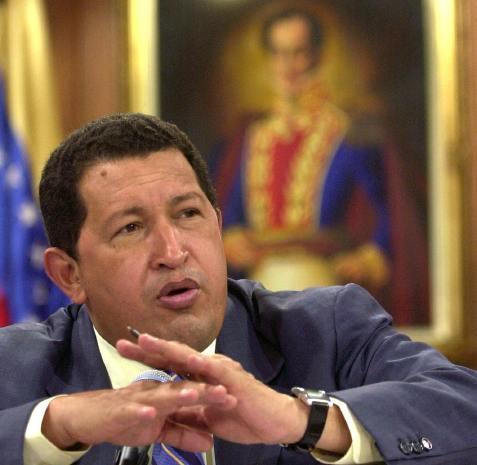
Hugo Chavez has been in power in Venezuela since 1988. Ever a thorn in the side of the US, he has vocally criticised Washington’s foreign policy whilst domestically implementing policies which fly in the face of US and IMF fiscal recommendations (in short, reducing the power and profits of corporations, and increasing direct benefits and assistance to the poorest people of his country). These policies have been wildly popular domestically, but have made him some powerful enemies (primarily the US, and the rich minority in Venezuela).

In 2002, he survived a coup that was almost certainly US-sponsored, with only a vast show of support on the streets forcing the return to power of the democratically elected Chavez.

The opposition secured a 2004 referendum on his leadership – Chavez won convincingly. In the Venezuelan congressional election late in 2005, the opposition parties pulled out of the running (a fairly clear attempt by the rich Venezuelan minority to destroy the legitimacy of the election, rather than risk another clear-cut defeat at the polls).

At one point, US TV Evangelist Pat Robertson actually espoused assasination: “We [the US] have the ability to take him out and I think the time has come that we exercise that ability”.

In the face of the constantly escalating rhetoric from Washington, Venezuela has been stockpiling weapons to guard against military action. This ranges from receiving 30 fighter planes, to 100,000 assault rifles (all from Russia). Arms discussions have also been ongoing with China, Brazil and Spain.

Chavez is also joining hands with his allies. He has called for Ecuador and Bolivia to be allowed to join OPEC, signed trade agreements with Bolivia, signed oil and energy agreements with Brazil, signed agreements to open Venezuelan oil fields to Chinese investment, and has agreements and proposals with Argentina covering everything from a gas pipeline linking Argentina, Brazil, Peru and Venezuela, an investment fund for Latin America, through to a South American union.

These events in Venezuela have to be seen in the context of a much larger swing to the left in South America – the biggest other example of this being Bolivia, where new president Evo Morales won his presidency on a platform of raising social spending and abandoning free-market policies. Morales has also dramatically pledged to join Venezuela in the “anti-imperialist fight”.

In short, there are serious problems developing in South America for the current US administration. Chavez is showing that the IMF formula for development (trade liberalisation, free movement of capital, “trickle-down” economics) is fatally flawed – and that taxing of the rich – both individuals and corporations – can deliver material improvements to vast numbers of the poor in vital areas such as healthcare and provision of education.

Would this matter to the US if Chavez wasn’t so verbally belligerent? The short answer is yes. The problem for the US in Venezuela is not just the alternative to the capitalist tradition of rewarding the rich at the expense of the majority – for Venezuela is only one country. The problem is that by implementing this alternative, acting in the best interests of the poorest in his society, and refusing to tow the US line, Chavez is providing an example to the hemisphere and the world – and it is in the providing of this example that Venezuela forms the greatest threat to US hegemony. Chavez has become the dreaded ‘bad apple’ that spoils the basket. He is rocking the boat, and the danger is that others might be inspired to follow - the same danger that has seen Cuba punished for decades.

So when Condoleezza Rice warns that Chavez is “one of the biggest dangers facing Latin America”, ask yourself this: to whom is he a danger? Why?

- - -

The US economy is in a disastrous state. Currently, the major props preventing its total collapse are the Chinese financing of US debt, and most of the world steadily purchasing dollars to function as their reserve currency – largely due to the dollars position as the currency required to purchase oil.

China are a growing power. As such, they will pull the plug on the US debt when it suits them. For other countries, the requirement to purchase oil in dollars is likely to continue until there is a viable alternative.
In November 2000, Iraq stopped trading oil in dollars, and started trading it in euros instead – a policy for which the then Iraqi administration and it’s people paid severely. (Again illustrating the point that any country setting a non-compliant example must be quashed immediately).
In June 2004, Iran announced its intention to set up an international oil exchange, trading in Euros. Month by month, the manufactured crisis with Iran grows ever deeper.
In May 2006, Chavez stated that Venezuela (the worlds 5th largest producer of oil) might price its oil exports in euros, as opposed to dollars.
Perhaps he is right to be purchasing weapons and forming strategic alliances after all.

Monday, May 29, 2006

Fight the real enemy

As a Hibs fan, it normally falls to me to revel in the discomfort of Hearts fans, and to take great pain from their success. This year, however, is different. The normal order has been at least temporarily overturned. The Old Firm have been split, and one half (Rangers) deprived of the Champions League for a year. At the risk of getting dizzy, a quick review of the last few epic managerial eras at Tynecastle is called for:

The Robertson Era (duration: 7 months)
Following Craig Levein’s tenure, John Robertson is appointed as manager, only to be sacked in May 05. Steven Pressley and John McGlynn take over until the end of season. Hearts court Bobby Robson, Lothar Matthaus and Nevio Scala as potential replacements

The Burley Era (duration: 4 months)

George Burley is confirmed as new Hearts coach in June with a 2-year contract. Following an astonishing early-season run of success, his contract disintegrates in October due to "“irreconcilable differences"” between Burley and the board. He leaves with Hearts topping the league, unbeaten.

3 days later, a spokesman for Vladimir Romanov promises on that he will not meddle in team selection. Hearts consider Bobby Robson, Nevio Scala, Claudio Ranieri and Kevin Keegan for the managers hotseat. Before October is out, both chief executive Phil Anderton and chairman George Foulkes depart (the hugely successful Anderton is pushed, with Foulkes jumping in protest) - Foulkes goes on to label Vladimir Romanov a "“megalomaniac". I can't imagine where he got that impression.”

The Rix Era (duration: 4 months)
November sees Hearts confirm Graham Rix as the new head coach. In February 06, he is joined by Jim Duffy as director of football. Just incase Jim gets too comfy in Gorgie, Rix is sacked in March with Duffy following him out the door. Valdas Ivanauskas appointed as interim head coach.

As this season comes to a close (we are seemingly still currently in the Ivanauskas Era, but check back regularly for updates), Hearts go on their summer holidays with two major things to think about: a vastly increased debt hanging over their heads, and the glory of the Champions League beckoning. Oh yes -– and the certifiable owner.

Notwithstanding the rolling farce that has been Hearts off-the-field season, they must be credited with an astonishing achievement in splitting the Old Firm by coming second in the league, and kicking down the door to the qualifying stage of the Champions League. The team and their fans deserve nothing but congratulations for their achievements this year.

Any force that can dent the domination of the Old Firm over Scottish football must be wholeheartedly welcomed. Despite Hibs local differences with Hearts, it is incumbent upon all Scottish football fans to welcome a challenge to Old Firm hegemony, no matter from which quarter that challenge comes. Hearts are currently asking the questions of the ugly sisters in Glasgow, and until Hibs are in a position to do so in a sustained manner, Hibees everywhere must continue to support the challenge that Hearts are mounting.

If they can sustain their on-the-field form with the insanity in the boardroom, season 06/07 should be another beauty!

Thursday, May 25, 2006

Genius becomes legend

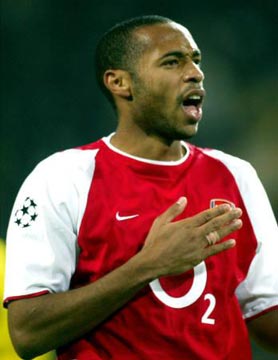
Over the last few years, no one has been able to touch Thierry Henry in the Premiership. A devastating package of pace, footwork, visionary reading of the game, and artistry and imagination of what might be possible - Henry has combined these with quiet dignity and professionalism to write his name large on the history books long before he has come close to hanging up his boots at the top level. Sporting journalists continue to scramble for unused superlatives to describe his sublime skills.

Following the defeat of Arsenal in the Champions League final last week, he engaged in off-the-field maneuvers that should catapult his status into a different dimension. With his contract at his club entering its twilight, and at least two Spanish clubs (certainly Barcelona, and presumably Real Madrid) courting him, he did the one thing that nobody expected him to do - and re-signed for Arsenal. In an age where professional footballers regularly seem to value money over loyalty, stability, and occasionally even first-team football, Henry'’s example to sporting youngsters is priceless.

To put the subject in some context, he is not going to struggle to pay his bills or get his groceries (reports suggest his new salary at Arsenal may be circa £110,000 per week). But consider also that he could have taken a money spinning move to many of the worlds top clubs. With the chequebooks of the biggest clubs in the world flapping in the breeze -– he re-signed for the North Londoners.

The new contract will run for four years, and Henry (who is now 28) has indicated he will see out his football life there. If during that contract, he can produce at Arsenal the quality of football of which we are all aware he is capable, the next few years will be utterly breathtaking.

His capacity to transcend the ordinary on the pitch has drawn gasps from all who have been privileged enough to witness it. In committing himself once more to Arsenal in the face of other opportunities, he should become nothing less than a legend.

Wednesday, May 10, 2006

New Moog!

Thoughts my synthesizer buying might be over for the time being were shattered by the Little Phatty at the Frankfurt Music Show in March. Opinion on this keyboard seems to be pretty violently split online, with many declaring it their latest lovechild, and others shunning it as a betrayal of all that is Moog.

Having seen it and played with it, I can report that it sounds amazing, and it looks utterly stunning – probably the most physically attractive keyboard I’ve ever seen. Whilst the internet opinion is split, my experience has been that everyone that has seen this thing in the flesh, wants one. Badly.

The first edition is a special tribute to Bob Moog (who passed away following his input to the initial design stages of the Little Phatty) – this initial tribute edition run being 1200 units only at around US $1,500. There is talk of a revamped full production model closer to the US $1000 mark following this, but with a pared down physical appearance - this is yet to be confirmed.

So long as you are behind me in the queue, let the stampede begin…

Tuesday, April 25, 2006

Dial-a-rant has arrived...

April 06 seemed as good a time as any.

More soon...