If I live to 80, I'll be unlikely to ever see a better Scottish goal.
Showing posts with label Sport. Show all posts
Showing posts with label Sport. Show all posts
Wednesday, April 01, 2009
Amsterdam, Paris, Beer, and Genius.
Having just returned from an insanely chaotic weekend in Amsterdam, following Scotland amidst thousands of Tartan Army, it seems like a great time to post this incredible video compilation of Scotland in France, 2007, and particularly the journey of the Dublin tartan army to get there.
If I live to 80, I'll be unlikely to ever see a better Scottish goal.
If I live to 80, I'll be unlikely to ever see a better Scottish goal.

Saturday, September 06, 2008
This is the one...
At 2PM today, Scotland embark on the qualification process for the 2010 World Cup -and I feel like I've only just gotten over the dissapointment of failing to reach Euro 2008. As a taster of the highs and lows to come, here's possibly the greatest football video clip I've seen put together.
Launched as a warm up video to the last qualification game for Scotland last time around (versus Italy), it's neither here nor there until about 1 min 34, where the review of the last campaign starts. I'm not usually a massive fan of Coldplay, but combined with Scotland doing this well, it puts the hairs up on the back of my neck.
Particularly great moments - at 3:03, Scotland 1, France 0. Scotland defeat one of the greatest teams in the world at home.
And then at 5:05, a not-realistically-fancied Scotland visit Paris for the return match, and James McFadden scores that goal. I still want to leap through the roof every time I see it.
So here we are, and here we go again. Come on now boys - this time...
Tuesday, September 02, 2008
Friday, November 09, 2007
Magic Sponge!

The rugby world cup of 2007 was a strange affair. Games that promised little delivered epic encounters. Games that offered huge match-ups fell flat.
The presumption prior to the tournament was that the ‘small’ teams would be swatted aside in a series of meaningless group games, leaving the big boys of the rugby world to entertain us in the knockout stages. Was that presumption ever wrong. Have the warm-up matches ever been more deceptive as to the final outcome?
Argentina sprang upon the world cup stage first, playing the hosts France, and delivered a statement of intent that could not be misunderstood by anybody. They took a disheartened-looking France apart. The Argentinians have long been on the wrong end of the world rugby system – getting hideous schedules in these tournaments while things are made easier for the so-called ‘big’ teams. Not allowed in the southern-hemisphere tri-nations, not allowed in the northern-hemisphere 6-nations. The black sheep of the rugby world, they came with a serious point to prove.
You knew that something was up before a ball was kicked. As the camera panned across the Argentinian team faces during their national anthem, you could sense something massive coming. The intensity of their expressions was on a different level, even for a competitive international game – some looked ready to burst, some looked furious, some were glazed, lost in thought, some had tears streaming down their face. Could they control their emotions? While you worried for the Argentinians if they couldn’t, you could only fear for the French if they could. Of course, they could, they did, and they humbled France, throwing the group that also contained Ireland wide open.
The Irish, inexplicably, self-destructed almost from the first game. A team filled with some of the most incredible individual talents in world rugby somehow managed to lose shape, direction, form, and ended up adding up to significantly less than the sum of its parts, submerging from the competition in the group stages. The Irish coach (having signed a four-year deal just prior to the competition) is presumably pleased that the crisis which exploded in Irish football immediately after the RWC diverted the national spotlight away from the immediate aftermath of his teams failure. Wales similarly foundered in the group stage, although they had the dubious compensation of participating in a deciding game with Fiji that could be used as an advert for rugby for the next 20 years. Scotland scrabbled out of their group after a nip-and-tuck decider with Italy, but were put to the sword in the quarters by Argentina.
Other great moments lit up the competition. France / New Zealand was a defining moment - the hosts taking on the favourites. While it’s difficult to like the way that New Zealand collect the cream of talent from the South Pacific, one of the appealing things about the All Blacks on the field has always been their refusal to lose, their relentlessness, their single-minded desire. One of the appealing things about France has always been their unpredictability – their mental imbalance. One half of a game they can be destroyed, hideous, a shell of a team. Then they can turn it on like it’s a tap – suddenly, the French flair is there, and they are the best team in the world. They did it to the All Blacks before in a world cup – and in 2007, they did it again – fighting back from behind to mug New Zealand in a massive show of heart, an incisive break from Freddie Michelak, swift hands and a killer try.
So as for the highlights of the world cup? I have four.
First is Argentina, bursting with pride and determination, turning France’s world upside down in the opening game.
Second is France, holding on by their fingernails for almost an entire match, staying in touch, and then finding a few minutes of inimitable French inspiration with the introduction of Michelak, and overturning an All Blacks side everyone had pegged to win the final.
Third is Sebastien Chabal. From a publicity point, the player of the tournament. But I pick him not for a moment of play, but for the expression with which he regarded the New Zealand ‘Haka’. There are many ways to stare down the Haka, but this was beyond intense. Check out the charged up expression Chabal has for the All-Blacks – and the raised eyebrows from the French player just after the end of the Haka is a nice touch too - here.
There’s a clip from the stands showing just how up close and personal it got here
(Note the All-Blacks crowding up in the French faces as it goes on – and the French sneaking over the halfway line (which you’re not supposed to do). No quarter asked for and none offered)
And just to confirm that the heroically violent sport of rugby is watched by gents, check out the crowd scenes in Cardiff before the match, as a large group of French encounter a large group of Kiwis. Brilliant.
Finally, as I was a lock forward, one for the real rugby players out there.
One of the latter Irish group games (possibly against the Argentinians, although I’m not sure). A ruck is on the ground, ball coming back on the Argentinian side. An Irish player is trapped head-and-chest on the wrong side, legs buried in the ruck. An Argentinian is trapped head-and-chest in the ruck, legs sticking out the Argentinian side.
As the Argentinian scrum-half comes in to collect the ball, the Irish player trapped in the ruck grabs an Argentinian leg (belonging to the buried Argentinian), and as no hands are allowed if you are on the ground, uses the spare Argentinian leg to poke the ball at the critical moment. The referee is unsighted by the bodies, and sees only an Argentinian foot poking the ball. The Argentinian scrum-half is subsequently faced with a ball zipping out of the ruck under his feet when he wasn’t ready for it, and onrushing Irish defenders.
While it wasn’t a decisive moment, it’s a great reminder of the hidden, beautiful moments that make rugby such a fantastic game.
Here’s looking forward to the six nations!
Thursday, December 21, 2006
Believe!
The update on our city rivals Hearts should really be an annual affair – but events this season have proven so insane that it’s already past time to take stock. As we left season 05/06, we were in the managerial “Ivanauskas Era”. A handful of weeks into season 06/07, things have become so confusing that it’s not even clear which era we are in. So far, this is how the 06/07 season is shaping up:
The Ivanauskas Era (duration: 7 months)
Graham Rix lasts four months before being replaced in March 2006 by Valdas Ivanauskas. Following winning the Scottish cup at the end of last season, Ivanauskas takes Hearts to second in the league behind Celtic, within 3 points as late as 24th September 2006. On Thursday 28th, Sparta Prague eliminate the Jambos from the UEFA cup, ending their European involvement for the year. On 15th October Hearts concede 2 points in a 2-2 draw to Hibs, followed by a 2-0 home defeat to Kilmarnock on 21st October, and it’s at this point that things start to unravel.
Ivanauskas refused to talk to the media following the Kilmarnock loss, and immediately flew to Lithuania to talk with owner Romanov. It was allegedly agreed that the manager would take a 2-week break to recover from stress. On 23rd October Eduard Malofeev takes the reigns as a caretaker manager, and as Ivanauskas indicates (3rd November) that he is not ready to return. At this point, Hearts began to officially refer to his absence as “indefinite”, which seemed to imply that the Ivanauskas era had come to an end.
The Malofeev Era (duration: 6 weeks)
Within 3 days the dawn of this bright new era, Racing Genk in Belgium ask FIFA to ban Hearts from any further activity in the transfer market, claiming that they are due 80% of the €835,000 fee allegedly agreed for the sale of Mirsad Beslija to Hearts.
Then the real craziness begins.
On 27th October, Romanov is reported to have told the Hearts first team that they would be “all for sale” should they fail to win against Dunfermline. Club captain and Hearts legend Steven Pressley appears with other core players Paul Hartley and Craig Gordon, and collectively issue a public statement lamenting the situation at the club. Highlights from Pressley include this: “There is only so much coaching staff, a captain and certain colleagues can do without the full backing, direction and coherence of the manager and those running the football club… I have worked hard to retain unity. However, due to circumstances, morale understandably is no good and there is significant unrest in the dressing room”. Former chairman George Foulkes, SNP leader Alex Salmond, and the Scottish players union back the statement by the three key Hearts players.
On Saturday 28th October, Hearts play Dunfermline at Tynecastle (with Pressley, Hartley and Gordon all featuring), and draw 1-1. On the 31st, Julien Brellier indicates he may leave Hearts due to lack of first team action (Breillier having been one of the most contentious issues during Romanov’s reign, with the owner apparently unwilling to allow successive managers to select the player). Saturday 4th November sees Hearts go down 2-1 to Celtic in Glasgow. On 7th November, in one of the most surreal happenings (to date), Hearts send their “Sporting Director” Alex Koslovski to field a standard press conference alone. Normally acting as the translator for Malofeev, Koslovski is unable to answer any questions from the press regarding tactics, formations, or players. When questioned on the appearance of FBK Kaunas (also owned by Romanov) manager Eugenijus Riabovas at the Hearts training ground, Koslovski asserts that Riabovas is in Edinburgh only for “professional improvement”, and not to replace Ivanauskas.
On 13th November Falkirk draw 1-1 with Hearts with captain Pressley absent, and the following day, Hearts confirm that Riabovas is to take the reigns are Hearts as “Temporary Head Coach”, whilst insisting that Pressley was absent from the Falkirk game as he declared himself mentally unfit to play. There are later allegations that Pressley heard of a plot to oust him from the captaincy involving the Lithuanian members of his team, and subsequently refused to make himself available to play.
On 19th November Hearts go down 0-1 to Rangers in Edinburgh, again without Pressley.
Protests erupt outside Tynecastle resulting in several arrests of Hearts fans.
On Tuesday 21st, Riabovas promises Lithuanian media that he will be traveling to Edinburgh in December to take the position as Hearts head coach.
The Riabovas Era (duration: 0 days)
On 24th December, Hearts announce that Valdas Ivanauskas is returning to retake the reigns in Gorgie.
The Ivanauskas Era II (duration: ?)
On Saturday 25th as Hearts draw 0-0 with Inverness Caley Thistle with Pressley finally playing, fans “declare peace” with Romanov, after a meeting of fans groups are assured that Mr Romanov “has no influence on team selection”, and that “Steven Pressley remains captain of the club”. Romanov goes on to refer to Pressley as the “cement” in the Hearts organisation. Sporting director Koslovski insists that Pressley simply had to prove his readiness in training before reselection. On 2nd December, Pressley is omitted from the side again, and Hearts draw 2-2 with St Mirren – the players union hits out at the “unconventional” treatment of Pressley. 2 days later, Edgaras Jankauskas refutes any dressing room plot to oust the captain, and on 8th December, Ivanauskas promises Hearts are close to a resolution with Pressley.
The next day, Hearts beat Motherwell 4-1, and later that evening, it is announced that Pressley is leaving Hearts “by mutual consent”. In the same manner as most of the exiting staff during Romanov’s tenure, it appears that confidentiality is a condition of whatever agreement is in place between the parties.
15th December sees Craig Gordon named as the new Hearts skipper, and Ivanauskas confirm that Paul Hartley “has a future at the club” (presumably he “has a future” in the same way that Pressley was “the cement”). Both players have separate disciplinary meetings with Hearts management, and both remain silent following these meetings on what was discussed.
On 20th December, an open letter on the Hearts Supporters Trust website lambasts Romanov, accusing him of acting “like a playground bully”, and turning the club into a “playground freak show”.
So as Hearts go into the festive end of the season, take a breath, wrap yourself in tinsel and get the popcorn out – there’s plenty more entertainment where this came from!
Monday, May 29, 2006
Fight the real enemy
 As a Hibs fan, it normally falls to me to revel in the discomfort of Hearts fans, and to take great pain from their success. This year, however, is different. The normal order has been at least temporarily overturned. The Old Firm have been split, and one half (Rangers) deprived of the Champions League for a year. At the risk of getting dizzy, a quick review of the last few epic managerial eras at Tynecastle is called for: The Robertson Era (duration: 7 months)
Following Craig Levein’s tenure, John Robertson is appointed as manager, only to be sacked in May 05. Steven Pressley and John McGlynn take over until the end of season. Hearts court Bobby Robson, Lothar Matthaus and Nevio Scala as potential replacements
The Burley Era (duration: 4 months)
George Burley is confirmed as new Hearts coach in June with a 2-year contract. Following an astonishing early-season run of success, his contract disintegrates in October due to "“irreconcilable differences"” between Burley and the board. He leaves with Hearts topping the league, unbeaten.
3 days later, a spokesman for Vladimir Romanov promises on that he will not meddle in team selection. Hearts consider Bobby Robson, Nevio Scala, Claudio Ranieri and Kevin Keegan for the managers hotseat. Before October is out, both chief executive Phil Anderton and chairman George Foulkes depart (the hugely successful Anderton is pushed, with Foulkes jumping in protest) - Foulkes goes on to label Vladimir Romanov a "“megalomaniac". I can't imagine where he got that impression.”
The Rix Era (duration: 4 months)
November sees Hearts confirm Graham Rix as the new head coach. In February 06, he is joined by Jim Duffy as director of football. Just incase Jim gets too comfy in Gorgie, Rix is sacked in March with Duffy following him out the door. Valdas Ivanauskas appointed as interim head coach.
As this season comes to a close (we are seemingly still currently in the Ivanauskas Era, but check back regularly for updates), Hearts go on their summer holidays with two major things to think about: a vastly increased debt hanging over their heads, and the glory of the Champions League beckoning. Oh yes -– and the certifiable owner.
Notwithstanding the rolling farce that has been Hearts off-the-field season, they must be credited with an astonishing achievement in splitting the Old Firm by coming second in the league, and kicking down the door to the qualifying stage of the Champions League. The team and their fans deserve nothing but congratulations for their achievements this year.
Any force that can dent the domination of the Old Firm over Scottish football must be wholeheartedly welcomed. Despite Hibs local differences with Hearts, it is incumbent upon all Scottish football fans to welcome a challenge to Old Firm hegemony, no matter from which quarter that challenge comes. Hearts are currently asking the questions of the ugly sisters in Glasgow, and until Hibs are in a position to do so in a sustained manner, Hibees everywhere must continue to support the challenge that Hearts are mounting.
If they can sustain their on-the-field form with the insanity in the boardroom, season 06/07 should be another beauty!
Thursday, May 25, 2006
Genius becomes legend
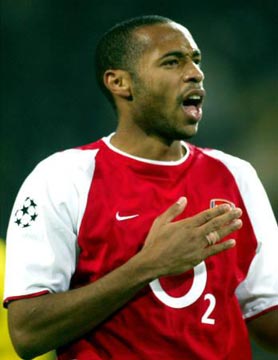 Over the last few years, no one has been able to touch Thierry Henry in the Premiership. A devastating package of pace, footwork, visionary reading of the game, and artistry and imagination of what might be possible - Henry has combined these with quiet dignity and professionalism to write his name large on the history books long before he has come close to hanging up his boots at the top level. Sporting journalists continue to scramble for unused superlatives to describe his sublime skills.
Following the defeat of Arsenal in the Champions League final last week, he engaged in off-the-field maneuvers that should catapult his status into a different dimension. With his contract at his club entering its twilight, and at least two Spanish clubs (certainly Barcelona, and presumably Real Madrid) courting him, he did the one thing that nobody expected him to do - and re-signed for Arsenal. In an age where professional footballers regularly seem to value money over loyalty, stability, and occasionally even first-team football, Henry'’s example to sporting youngsters is priceless.
To put the subject in some context, he is not going to struggle to pay his bills or get his groceries (reports suggest his new salary at Arsenal may be circa £110,000 per week). But consider also that he could have taken a money spinning move to many of the worlds top clubs. With the chequebooks of the biggest clubs in the world flapping in the breeze -– he re-signed for the North Londoners.
The new contract will run for four years, and Henry (who is now 28) has indicated he will see out his football life there. If during that contract, he can produce at Arsenal the quality of football of which we are all aware he is capable, the next few years will be utterly breathtaking.
His capacity to transcend the ordinary on the pitch has drawn gasps from all who have been privileged enough to witness it. In committing himself once more to Arsenal in the face of other opportunities, he should become nothing less than a legend.
Subscribe to:
Posts (Atom)

 Posts


