Thursday, August 28, 2008

Jordi Fornies

I've never been one for much art (as in the visual, rather than the musical) - either traditional, modern, sculpture, or what have you.

But I'm making an exception for the Barcelona born artist Jordi Fornies, whose "Metaphors" exhibition opens September 3rd in Dame Street Gallery, Dublin.

There's something amazing in the way that he mixes textures, colours and materials that's very immediate - and more than that, many of his paintings seem just so inspiring.

As a couple of examples, check the following two paintings:


"Broken Silence"


"Here to There"


Check Jordi's site out here, and also at his agents site here.

Great stuff.

Wednesday, August 27, 2008

Ghostplane

Read about extraordinary rendition here, as reported by Stephen Grey, who has been following this story for a considerable amount of time...

Monday, August 25, 2008

Man On Wire

"Man on Wire" is the story of Philip Pettit, the Frenchman who in 1974 attempted to walk on a tightrope between the two towers of the World Trade Centre in New York.

I'd highly recommend seeing it - as well as being an often funny and entertaining look in to the mind of someone so driven and eccentric (he could only really have been French), it's an astonishing window in to what is possible.

It all sounds like a zany if unlikely idea until the shots start of the rigged cabled at the top of the towers, and you consider actually putting your feet on it...

Jaw-dropping.


Friday, August 08, 2008

Listen for the surge

The surge in Baghdad is working - the level of violence is reducing. This is what we are told.

Check this three-part series of videos from Ghaith Abdul-Ahad, which tell a dramatically different story.

Part 1


Part 2


Part 3

Monday, July 28, 2008

No means no


Last week, an organisation in the UK commissioned a poll of 1000 people in the Irish electorate, to explore views regarding the Lisbon Treaty, which was rejected by a healthy margin in a referendum last month.

The poll revealed that 71% of those polled oppose a second referendum on the Lisbon treaty, with 62% saying they would vote “no” if asked again (an even higher margin in favour of voting ‘no’ than that achieved in the official referendum.)

The Irish Foreign Affairs Minister Michael Martin has now accused the UK group involved (apparently a ‘eurosceptic’ think tank) of “meddling in [Ireland’s] national debate on the Lisbon Treaty”.

In what way is taking an opinion poll meddling?

As the electorate of Ireland have categorically rejected the Lisbon treaty, perhaps the government might like to spell out exactly what “debate” it is we are now supposed to be having?

Perhaps in this instance, it might be in the greater interest of Brian Cowen and his cronies to stand up straight and represent the views of the Irish people to the European politicians, rather than trying to impose the views of European politicians on the Irish electorate.

These would be the same European politicians who, when confronted with an amendment to the Lisbon Treaty stating “The European Parliament undertakes to respect the outcome of the referendum in Ireland”, voted “No” (499 to 129) to the amendment.

They may not respect the outcome of the referendum, but that doesn’t mean that the Irish cannot vote however they want.

Also, those parties in Irish government might like to reflect on the likely domestic political implications for them if they choose to go for a second referendum on Lisbon, and then fail to get it through.

No means no…

Thursday, July 24, 2008

Extreme Crosswinds

Ever been in a plane and thought you had a rough landing? A few bumps from wind are ok - the real fun comes when the wind is blowing sideways across the runway - the hated crosswind. Instead of pointing the plane directly at the runway, you have to cant the nose sideways into the crosswind, and allow the aircraft to effectively crab diagonally forward.

And then the fun part being that as you hit the runway, you have to twist the plane back in line with the runway, so that as the wheels grip, you don't run off sideways due to your diagonal approach. Of course, nothing is more fun than an extreme crosswind landing!

Here's a Korean Airlines 747, which having survived the insane approach to the old Kai-Tak airport at Hong Kong, comes out of the final big turn and then manages to mess up his approach horrifically in quite a light crosswind. This should really have resulted in a go-around, and the pilots insistence in sticking it on the runway only just comes off.


Here's an example of someone getting it very, very wrong in a much smaller Airbus, trying to set down in Hamburg, in a much more extreme crosswind situation.


Having nearly decorated the airfield with the plane, the pilot ultimately does well to perform a go-around and manage to get it back in the air again in one piece.

It puts in perspective what most of us mistakenly call a "rough" landing...

Tuesday, July 22, 2008

Electronic Dancing Music

Wandering aimlessly around the music blogs recently, I stumbled across this post by Pipecock over at Infinite State Machine, which references this post by Ronan Fitzgerald, which references this post by Philip Sherburne on Pitchfork.

The Philip Sherburne post seems to amount to musings along the lines of “everything seems quite grim at the moment”. Ronan Fitzgerald nuances this with an assessment that seemingly the dance music scene hates itself at the moment due to an overload of minimal hype that has yet to be replaced with something else, and points out that purism tends to ignore the murky and druggy aspects of dance culture, that he (rightly I think) points out are nearly as fundamental as the music itself.

I think the minimal hype overload thing is a bit annoying, but it's not so difficult to avoid - just keep buying records (or making records) instead of paying so much attention. The process of the underground spawning mini-scenes for the mainstream to hype for 2-3 years has been going on ever since I've been interested in dance music, and having that overground part taking all the attention seems to be quite a reliable and efficient way of allowing the underground to stay where it is, doing the inventive stuff.

But Pipecock’s post is by far the most interesting, recontextualising the discussion in terms of what dance music is really about, and since this leads him to consider some of the most interesting aspects of the dance music experience, it’s well worth a look over.

Quoting from ISM:
"The reason house and techno are effective is that they bypass so many of the limitations that other musics have and go straight for people’s emotions."
This goes to the heart of the attraction of dance music - there is something in the driving loop of a house groove that is deeply entrancing, to the point where your brain does start to function differently, particularly as you dance. I'd go so far as to say the appeal of the cranking looping kick drum is to a place even deeper than your 'emotions', and Pipecock’s allusion to a Zen analogy may not be too far off. As the KLF said in their tongue-in-cheek (but spectacularly insightful) book “The Manual”, “it is through dance music and dancing we are able to get momentarily back to the Garden”.
"Musicians talk about music “writing itself” while athletes routinely make plays that they wouldn’t have thought possible. It all comes from letting the mind go, which is exactly the opposite of the way these critics have been approaching dance music."
This is a problem, but it’s a problem that is difficult to surmount. Any discussion of dance music necessarily requires an intellectual response, but the ‘switching off’ nature of the dance experience in it’s proper context is one of de-activating some of the higher functions of the brain (such as analysis and ego), in favour of the lower and more primal functions (direct experience and id). It’s difficult to critically analyse music whose central experience revolves around the suspension of analysis – and while this doesn’t mean that analysis of dance music is invalid (many great house and techno tracks stand up to analysis just fine), it is important to be aware of the contradictions implicit in analysing music in this way.
"Thought is required to use Ableton to deejay, the actions are more mental than physical and that diminishes the ability to reach the point of “action without thought”. The same goes for the producers who are more like computer scientists than musicians in many cases."
I have a couple of problems with software such as Ableton (amazing though it is), one of them being the “computer scientist” performance that it tends to elicit from the DJ. While really it should be all about the audio experience, you can’t help but be affected by the attitude and energy coming from the DJ themselves. Another problem is that Ableton and similar Djing software tend to result in perfect beatmatched tracks. There is the argument that beatmatching itself is a redundant and purely technical skill, and automating it allows the DJ to concentrate on selection, set progression, ‘mixing’ between the tracks and parts, etc etc etc. This would be a valid argument if the human beatmatching process contributed nothing to the experience, but I feel there is something in the imperfections of manually mixed tracks that imparts a uniquely human energy to a mix. There’s nothing like the buzz of dancing away, while a mix of two records slowly gets pulled in to shape by the DJ. For an example, listen to Jeff Mills “Live in Tokyo” album – it’s far from perfectly nailed timing, but it has an awesome raw energy to it, partially imparted by the fact you can hear the human pushing, dragging, and willing the records to sit together as he blisters through his set at a jaw-dropping rate.

As for computer software and interfaces when writing music, this is one of the biggest issues for me when writing in music. While I do use a computer, I try to use it as little as possible, and only for the things that it can do best – hardware for me is much more conducive to creativity. This is largely a matter of taste, but I believe that computers and music software in particular have way too many options, and then force you to access these options via the most narrow and awkward of interfaces (mice and keyboards). It compounds the “painting the hallway through the letterbox” problem of programming early digital studio hardware on tiny LCDs, with the problem exacerbated by having so many options in the software to begin with. It becomes very hard to apply quality control, as the endless range of miniscule editing options leads you to believe that endless tweaking of a mediocre idea might turn it into a great track. All of this tweaking costs energy, and I find it ultimately far more inspiring to have hardware with less options. This means your idea is either good straight away, or not good enough – in which case you can ditch it and move on to the next idea.

Ultimately, the problem is one of barriers between us and experiencing music as directly as possible. Be it the problem of critical analysis interfering with our direct listening or dancing experience, or be it Ableton Live interfering with our experience of the human playing the music, or be it with heavy music software in the studio interfering with our ability to quickly and directly interpret musical ideas without breaking out of the creative moment, the problem is the same.

Any time that we allow barriers to be raised between us and our direct experience of the music, something is lost - and the removal of these barriers (whether naturally or with assistance) is what makes the experience of dancing to this music so alluring.

Friday, July 18, 2008

Terrorist Watch List


Today, Counterpunch carries the quite stunning news that the US terrorism watch list now contains 1 million people.

1 million people!

The list includes such luminaries as the ex-assistant US Attorney. That's right - the terrorist watch list is now so large, it's starting to assimilate the higher parts of the US governement itself. As The Matrix's Morpheus might have said: clearly, police states are not without a sense of irony.

Those in Britain - now the country with the most closed-circuit TV cameras per capita of any country in the world, might want to stop giggling at this point. As has been very astutely pointed out, once the camera apparatus is physically in place and face recognition software becomes robust enough (if it isn't already), following the movements of everyone at every moment simply becomes a problem of networking and processing power.

Thursday, July 10, 2008

Informed Comment

Here's another blog on the politics tip that's utterly fascinating - Informed Comment, by Juan Cole.

Cole is (I think) a professor at some US college, and he presents daily dissections of US foreign policy, the Middle East, and generally very fairly assesses what is going on - compelling reading.

Tuesday, July 08, 2008

John D McHugh

Here's a blog worth reading... John D McHugh is an Irish photographer and journalist, who was injured while embedded with the US forces in Afghanistan.

He's now back in Afghanistan, back with the US forces, and telling the story from the ground.

While I have my own opinions on whether US and European troops should be where they are, I do think he's telling a story that is a bit missed generally - the story of what it is like for the soldiers on the ground.

Check out his new diary of this year in Afghanistan here - now added it to the list of recommended blogs.

Friday, July 04, 2008

E-MU SP1200

Today I had the honour of taking apart the peerless SP1200 sampling drum machine. One of the original hip-hop machines (well, that was really the SP12 but let's not pick nits), this thing is a legend. Google for SP1200 and it quickly becomes clear.

It's always a bit bizzare when you take apart a bit of music gear, and suddenly find the electronics that make it work - something you tend not to think about when writing the music.

Here's the main circuit board on the SP - a frightening array of chips:

And from another angle. It was 1985 I suppose - but all this technology gives you a grand total of 10 seconds (!) of sampling time. Chiporama.

As with many early E-MU hardware units, there are cryptic inscriptions screened on the boards. On the reverse of the front-panel circuit board, you find this:

Anyone anything to offer on who Louis McCrawfish might have been?

Finally, a shot of the front-panel board (sitting out of the machine), across the top of the 8 volume faders that launched a million hip hop hits.


I remember sampling a little Boss drum machine on the SP1200 I used to own. What went in sounding tinny and thin came back out of the SP sounding like God playing Satan's own drumkit.

It's inspiringly simple to use, and what comes out aren't "drums" - they're devastatingly heavy, punchy and gritty 12-bit impacts.

Does music hardware get any better?

Friday, June 27, 2008

Sightseeing by Satellite

So I’m messing around on Google Maps recently. It turns out that the more you look for, the more amazing things you find.

I initially started out browsing places I had been. Searching for a big shopping centre in Los Angeles, I came across an airliner seemingly parked in the car park.


Of course it’s actually several thousand feet up, most likely going in to our out of John Wayne airport, but it got my interest going.

Next up was a quick flick at Frankfurt, where a scan of the airport revealed an even more bizzare photographic anomaly – a 747 caught climbing out of the airport, snapped three times in succession by the satellite. Not that I’m that much of a geek, but I guess that this would give you the frame rate of the satellites that Google uses if you could be bothered to do the maths.


Having found that, it just became a general sightseeing mission. First up, Murrayfield (the Scottish Rugby ground), captured in pretty impressive high resolution:
From Edinburgh, on to some of the Middle East’s finest sights – the great Pyramids at Giza:


And the Ka’bah at Mecca, Saudi Arabia:


The nutsoid Burj Al Arab hotel on the coast of Dubai (the one that looks like a sail):

And some European highlights, including Venice:


And down the coast of Italy, the near perfect volcanic cone of Vesuvius:


The Eiffel Tower, in Paris


And on the European historic tip, the Brandenburg Gate, Berlin. If you open the link and zoom in, you can clearly see the line of bricks paved in the semi-circular road that mark the actual line of the removed Berlin Wall.


I hereby release myself from all claims should you become addicted to zooming in and out of places that you have or haven’t been!

Wednesday, June 18, 2008

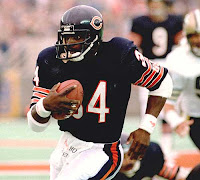
Walter Payton – “Never Die Easy”

This is a book that I would recommend to everyone.

Payton was arguably one of the best (if not the best) American Football player to have ever lived. Read this book by written by Payton with Don Yeager and you will discover not only why he was a great football player, but also why he was an incredible human being.

Written in the last weeks of Payton’s life, this is probably the best book I have ever read, about anything. I found it impossible not to become inspired, emotional, and just plain awed by his greatness, his humility, and the perspective he brought to his own life and the way he related to those around him.

Without any intention to infringe copyright (or spoil the book), here are some selected sections, which without even coming close to telling the whole story will give you a flavour.

---

The most prolific running back in the history of the National Football League started his storied career not with a bang but with a bust. Eight carries for zero yards as the Bears lost 35-7 to the Baltimore Colts. After the game he cried. “Zero yards, but it was like I’d just watched someone gain 150,” said teammate Mike Adamle that day. “He made a couple of moves in the backfield after he was stopped for losses, just to get back to the line of scrimmage, and I said, “This guy’s great.” And he got zero yards”

But while the numbers weren’t there [in his initial season] as he played for the hapless Bears, the skills and determination that would lead him to the Hall of Fame were clearly on display. Payton was his normal self, scrapping for every yard no matter how far in the backfield he was initially hit, no matter how many opposing linebackers were leaping on top of the pile, no matter how far behind in the game the Bears were. He fought for extra yards on late-game third-and-longs during blowout losses as if it were first-and-goal in the Super Bowl.

---

On a team that consistently struggled, Walter was the guiding light. By year two… he began hitting his stride, rushing for 1,390 yards and thirteen touchdowns, finishing just behind O.J. Simpson for the league rushing title. In his third season, at age twenty-four, Payton was named the League’s Most Valuable Player, the youngest player ever to receive the honour. He earned it, scampering for 1,852 yards and fourteen touchdowns… including a 40-carry, 275-yard game against the Minnesota Vikings, still an NFL record for yards gained in a single game. He did it all that day despite suffering from the flu.

---

His complete, all-out style of play made him a fan favourite not only in Chicago but throughout the league. In 1981, the struggling Bears played a powerful Dallas squad on Thanksgiving in Texas and lost 10-9. Payton was never better, running like a man possessed, determined to win one on national television despite playing for a team lacking talent. He finished with 179 yards on thirty-eight carries, and as he left the field, head down in defeat, he received a rousing standing ovation from Cowboys fans awed by his effort.

It became a weekly occurrence, Walter receiving huge ovations from opposing fans who appreciated his abilities and style. He became one of the league’s most popular players despite toiling for a losing team. The ultimate sign of respect came in Green Bay – home to the Bears’ ancient and despised rivals – where, as his career wore on, he began receiving standing ovations from the Lambeau faithful during the pregame introductions. It was the first time a Bear has ever been cheered in Green Bay. And the last.

---

On his first trip away as a Bear, he sat in the first window seat on the left side of the plane in the coach [economy] section. At the time, the veteran players, particularly the stars, took the first-class seats and the rest of the team sat in coach. Walter sat in that same seat for every flight for his entire career. Long after he could have moved to first class and stretched out, he stuck with the rank and file of the team and flew coach class.

---

Mike Singletary: “Walter never gave us a lot of speeches about what it took to be a professional. He never took rookies aside and discussed it with them. He led by example. It is the best way to teach people. Little things are always caught by people. Even my own kids catch things. That’s something I have to remember myself, to lead by example. It’s a lot easier to talk, but man, I tell you what, walking that talk is very, very difficult. And Walter walked the walk every single day and the rest of us watched in awe.”

---

Kim Tucker: “I remember a woman who volunteers quite a bit at the foundation, and she was telling me that when she was a teenager that the Boys and Girls Club had held an event at a real nice hotel, and it was in a really nice suite at the hotel. It was a fund-raiser, so everybody was there, they were all people that had money and were all dressed very nice. These two teenagers were there and they were kind of just alone, nobody came up to greet them or anything.

She’ll never forget that when the elevator opened and Walter Payton walked out of the elevator, he looked around the room, and spotted them, and everybody’s running over to greet him, and he’s smiling at everybody and waving and telling them, putting his finger up, saying, “I’ll be right back,” ran right over to them and grabbed and hugged them, and said, “It’s great that you’re here, I’m so excited to be able to come and be part of this.” She said that when Walter came over, then everybody else wanted to come and meet them too. It was then okay to go up and hug these kids.”

---

Mike Lanigan: I called him on his mobile and acted like I was not aware of what he was going to tell me.

I said “Walter, how are you doing?”
He said, “Well, Mikey, I got some good news and I got bad news. Which one do you want to hear first?”
I said, “What do you mean, Walter?”
He says, “What do you want to hear first?”
“Tell me the bad news.”
He says, “Mikey, I’m not going to be around very much longer.”
I say, “Oh, don’t tell me that, Walter…. What’s the good news?”
“I’m alive today.”

Think about that. That was his attitude from then on.

---

Mike Singletary: Walter taught me to smile and he taught me to be courageous. And the other thing he taught me was to be a professional and how to handle myself. There were some games that we played, there were times that he played against some great athletes. I don’t care who they were, sometimes he would get the crap knocked out of him, bounce right back up. Bounce right back up. Wouldn’t say a word, he would turn and give the ball back to the referee, straighten up his helmet, and go back to the huddle. You knew at that moment he was saying, I’m coming back. Get ready, I’m coming back, and I’m coming with all I got. To me, that’s what he exemplified. When I looked at him, no matter what I felt like before a game – when I saw him run with such courage and authority – I don’t care who you were, he was going to dish it. He was gonna hand it out, he was gonna do the punishing, he was going to set the tempo.

---

Walter Payton: That’s the way everyone should really want to be remembered, that whatever they did, they did it as best they possibly could. That’s all anyone should want in our life. It’s not being the best, it’s not winning this or not holding this record… but for people to say, while he was on the football field he gave all he had, and then when he was off the football field he was just that much of a person that you could relate to, that you could talk to, that he had feelings. That’s what you want to be remembered as. Because football is a business. Walter Payton is a human being. If all I’m remembered for is a bunch of yards and a lot of touchdowns, I’ve failed. That was just my work. I want to be remembered as a guy who raised two pretty special kids and who taught them to be great people. Please have them write that about me.

---

Buy “Never Die Easy” by Walter Payton with Don Yeager (Random House publishing), wherever you can find it.

Contribute to the Walter and Connie Payton foundation here.

Friday, June 13, 2008

Laura Clapp - “Leaving Nashvegas”

Laura Clapp has a new CD out, and I’d highly recommend it to all.

Recorded (almost entirely live) in Nashville, it’s a fantastic collection of tracks. With stunning and direct songwriting, hooky choruses, great arrangements, and really well recorded and mixed, it’s a CD you could listen to over and over again.

It's also accompanied by one of the best constructed artist photographs I've seen - which somehow manages to combine music and artistry, a dichotomy between strength and a hint of crucifixion, wedding rings, and even matching coloured nails and watch face. I have no idea if that was all planned, but it's an amazing photograph either way.

Some of the really good tracks include the gorgeous acoustic guitar led “Back to Us”, “Beautiful Limbo” (which to my ears is dying to be catapulted into the charts in a fully blown studio recording), the haunting drawl of “Something about you”, and the devastatingly underdone “Not for Me”, which rounds off the collection.

You can get the CD from Laura’s website here – so get one, and if you are quick you can say you knew about her before she was huge.

Friday, June 06, 2008

Ireland must vote No to the Lisbon Treaty

In one week’s time, Ireland will vote on whether to ratify the Lisbon Treaty.

The last time something like this came around was in 2005, when the electorate of France and the Netherlands both voted “No” to the EU Constitution. Since then, European politicians have been tinkering with the formula, trying to preserve as much of the failed EU Constitution as possible, without calling it a constitution. Giuliano Amato (the vice-chair of the convention responsible for drafting the EU Constitution) stated “The good thing about not calling it a Constitution is that no one can ask for a referendum on it”.

Ireland is in a unique position, as due to the constitution of Ireland, a referendum is absolutely required. The Irish electorate will be the only non-politicians to be asked to approve this treaty, across 27 European countries!

The treaty is impossible to read, which is a good reason to be very suspicious.

There are many bad parts of this treaty, but the main part to be worried about is that part of signing up means that you agree the treaty can be changed after the fact, without your further approval. In that sense it is a blank cheque – and changes might be made that could be pushed through without a referendum at a later stage. In other words, this would be the last time that the politicians had to worry about the Irish public actually being able to make a meaningful decision. It’s clear that after the disaster of the Netherlands and France expressing their democratic right to decide (and deciding the way the politicians do not want), they will do everything to avoid having to ask the public for our opinion.

This treaty obliges Ireland to increase military spending. It provides a means for the EU to promote Nuclear Energy. It undermines workers rights (and if you are a normal person working for money, you are a worker). It passes 105 powers to the EU from Ireland (including International Relations, Security, Trade and Economic Policy), and more than 60 of these power-transfers may see Ireland unable to stop law changes that are not in the interest of Ireland.

There is nothing un-European about voting no to Lisbon. I am pro-Europe, and the way to make Europe more like it should be, is to protect our right to decide who speaks for us. Millions of electors across Europe are relying on us and our right of referendum (enshrined in the Irish constitution – at the moment) to vote no on their behalf.

It’s always possible to agree to changes to Europe at a later date. A no vote is not a step backwards - Europe is functioning quite well as it is, the world will not cave in. The politicians are entitled to redraw their proposals again, and bring them back to us.

But from a ‘Yes’ vote in Ireland, there is no way back. We will not be asked again, and the politicians can decide what you said ‘yes’ to after you have committed.

One final point - this treaty is unreadable, and can be changed after you agree to it in principle.

Would you sign a contract that was so complicated it was impossible to read, and that could be changed after you signed it by the other party?

Do the right thing for Ireland, the right thing for people across Europe who don’t have the privilege of a referendum, the right thing for you - vote no.

Friday, May 23, 2008

Peak Oil

If you haven’t read about peak oil, now might be a good time to start.

Oil is a finite resource. We are consuming it at a rate which will exhaust it completely (this is not in question). So what is the ‘peak’ bit? The peak bit is, at some point we will reach a stage where all major oilfields have been discovered and exploited, and the ‘production’ of oil will be running at it’s historical maximum. Then, slowly, production will start to wind down, as the oil continues to be depleted with no new discoveries being available.

As oil goes past this ‘peak’ of production, there will still be a lot of oil left – but as production starts to come down slightly, the demand for oil will very very quickly outstrip the supply. This will mean two things – firstly, constantly rising prices. Secondly, rationing of oil, and spreading it out thinly to essential services. There are good sites which give a bit of a deeper background on peak oil here and here, and another great article here which explains why the tailoff in oil availability following the peak may not be the smooth ride into the post-industrial abyss that would be the preferable option.

This wouldn’t be so critical, if all of the industrialised western world was not completely contingent on a continuing supply of cheap oil. As the price of oil skyrockets, and supply becomes limited, the wheels are going to come off the current way we live.

Oil is the basis for all transportation – of you, of everything you eat, everything you purchase (how do you think it got to the shop?), and most likely how you get to work and back. All of this will be stood on its head when Peak Oil strikes, and we don’t look too ready.

When will the peak be? Nobody can be sure - some think it may have already happened. One thing which is for sure, is that we won’t know when it happens until after it has passed.

If you can’t grow potatoes and tend chickens, now might be a good time to learn how. (Unless your in Southern California, in which case you’d better hope that you can survive on the oranges that are left when the water isn’t pumping any more)

Monday, May 19, 2008

Theo Parrish – “Falling Up” (Carl Craig remix)


Carl Craig is one of the most prolific remixers on the scene these days. While some of his stuff is a bit ‘miss’ for me, he does occasionally produce something that is genuinely jaw dropping. For examples, check his remix of “Domina” by Maurizio, or his reworking of “Nairobi” by As One on New Religion. Both of these remixes trawl the deeper and more emotional recesses of dance music.

On this remix of “Falling Up”, Craig does something that looks much more to the dancefloor, and in the process creates an absolute monster.

Starting off with an even-tempo clicky rimshot-driven beat, it loops round and round for a minute or two, before the pivotal sound of the remix fades in. It’s a grinding, droning one-note chord noise, pulsating in time with the beat. It covers three devastatingly simple notes over 2 bars, then returns and starts the cycle again, over and over. It’s like the techno interpretation of the scene in “Close Encounters” where they are determining the perfect way to communicate with the aliens.

“Root note.”

“Root note again.”

“Go up a perfect fifth.”

“Up another perfect fourth, and hold it.”

“Ok – keep repeating that.”

Once this pattern starts to burn itself in your brain, and the beat is locked in, then the kick drum drops and the intensity cranks up another notch. This is a ferociously addictive record. (What is it about mantra-like repetition in music that appeals to a certain part of your brain?)

Another couple minutes of the thudding kick drum, the neatly clicking rimshots, and the grinding, pulsating, insistent synth, and then a set of neatly shuffling brushes are added to the mix. Suddenly, the kick drum has a lifting offbeat to play off against, a slice of freshness is added to the unrelenting drive of the chord drone, and from nowhere, the track has bounce.

Another minute, and a held synthline comes in, hanging on the 5th.

There’s something about suspended notes over driving drumbeats that is magnetic, and for some reason, none more so than the suspended 5th. As it grows and grows, suddenly there is a slight phase, and dissonance, and suddenly the suspended synth note starts to wobble and diverge, with two identical notes slowly parting tuning company. The further they go apart, the more harmonic friction is created, the more energy is released.

And all the time, the grinding chord is pulsing out the 3-note pattern, over and over. This is a heavy riffing monster of a track.

Released in 2006, it’s slightly old now (and a bit hammered, as it was understandably wildly popular when it came out) but it’s difficult to believe that this won’t be one of “the” remixes that will withstand the test of time, and end up rightly regarded as a classic.

Wednesday, May 07, 2008

François K - Road of Life


For the first time in ages, a house 12" single that's nearly faultless. François Kevorkian has done some amazing tunes and mixes over the years, but they can be a bit hit-and-miss. This one, however, is a hit and then some.

The original version of "Road of Life" is super-slow deep and spacey house, probably too slow for the dancefloor in fact. But it's got so much depth and is so musical, that it commands attention. Perhaps music for the head rather than the feet, but no less brilliant for it.

On the flip side, the "Quiet Village" remix is something else altogether. Ditching most of the elements of the original, this speeds up the track to an even-paced minimal house track, which loops around for the best part of 10 minutes. Rotating around strident walking-speed drums and a clarion-call synthetic bell sound, it's tough, grinding loopy dancefloor house of the highest order.

Highly recommended!

Wednesday, April 30, 2008

A land without people?

How does Israel treat the Palestinian civilians for whom it is responsible while maintaining it’s utterly illegal occupation of Palestinian territory? There’s a good article in the Irish Independent here, which sheds some light on one aspect of the collective punishment.

The more vivid points are outlined as follows:

“Across the occupied West Bank, raw untreated sewage is pumped every day out of the Jewish settlements, along large metal pipes, straight onto Palestinian land. From there, it can enter the groundwater and the reservoirs, and become a poison.”

“in order to punish the population of Gaza for voting "the wrong way", the Israeli Army are not allowing past the checkpoints any replacements for the pipes and cement needed to keep the sewage system working. The result? Vast stagnant pools of waste are being held within fragile dykes across the strip, and rotting. Last March, one of them burst, drowning a nine-month-old baby and his elderly grandmother in a tsunami of human waste. The Centre on Housing Rights warns that one heavy rainfall could send 1.5m cubic metres of faeces flowing all over Gaza, causing "a humanitarian and environmental disaster of epic proportions".”


In other news, Israel is to build another 100 settler homes (BBC article here), in flagrant violation of a stack of UN resolutions.

If Israel cannot keep to the 1967 borders and dismantle the illegal settlements in the (illegally occupied) West Bank, how about we abandon the 2-state solution, and instead have a 1-state solution, with all Israelis and Palestinians living in the same state. One person, one vote. Surely the self-styled “only democracy in the Middle East” couldn’t object to that?

Failing that, how about an EU goods and services embargo against the increasingly apartheid Israel?

Friday, November 09, 2007

Magic Sponge!

The rugby world cup of 2007 was a strange affair. Games that promised little delivered epic encounters. Games that offered huge match-ups fell flat.

The presumption prior to the tournament was that the ‘small’ teams would be swatted aside in a series of meaningless group games, leaving the big boys of the rugby world to entertain us in the knockout stages. Was that presumption ever wrong. Have the warm-up matches ever been more deceptive as to the final outcome?

Argentina sprang upon the world cup stage first, playing the hosts France, and delivered a statement of intent that could not be misunderstood by anybody. They took a disheartened-looking France apart. The Argentinians have long been on the wrong end of the world rugby system – getting hideous schedules in these tournaments while things are made easier for the so-called ‘big’ teams. Not allowed in the southern-hemisphere tri-nations, not allowed in the northern-hemisphere 6-nations. The black sheep of the rugby world, they came with a serious point to prove.

You knew that something was up before a ball was kicked. As the camera panned across the Argentinian team faces during their national anthem, you could sense something massive coming. The intensity of their expressions was on a different level, even for a competitive international game – some looked ready to burst, some looked furious, some were glazed, lost in thought, some had tears streaming down their face. Could they control their emotions? While you worried for the Argentinians if they couldn’t, you could only fear for the French if they could. Of course, they could, they did, and they humbled France, throwing the group that also contained Ireland wide open.

The Irish, inexplicably, self-destructed almost from the first game. A team filled with some of the most incredible individual talents in world rugby somehow managed to lose shape, direction, form, and ended up adding up to significantly less than the sum of its parts, submerging from the competition in the group stages. The Irish coach (having signed a four-year deal just prior to the competition) is presumably pleased that the crisis which exploded in Irish football immediately after the RWC diverted the national spotlight away from the immediate aftermath of his teams failure. Wales similarly foundered in the group stage, although they had the dubious compensation of participating in a deciding game with Fiji that could be used as an advert for rugby for the next 20 years. Scotland scrabbled out of their group after a nip-and-tuck decider with Italy, but were put to the sword in the quarters by Argentina.

Other great moments lit up the competition. France / New Zealand was a defining moment - the hosts taking on the favourites. While it’s difficult to like the way that New Zealand collect the cream of talent from the South Pacific, one of the appealing things about the All Blacks on the field has always been their refusal to lose, their relentlessness, their single-minded desire. One of the appealing things about France has always been their unpredictability – their mental imbalance. One half of a game they can be destroyed, hideous, a shell of a team. Then they can turn it on like it’s a tap – suddenly, the French flair is there, and they are the best team in the world. They did it to the All Blacks before in a world cup – and in 2007, they did it again – fighting back from behind to mug New Zealand in a massive show of heart, an incisive break from Freddie Michelak, swift hands and a killer try.

So as for the highlights of the world cup? I have four.

First is Argentina, bursting with pride and determination, turning France’s world upside down in the opening game.

Second is France, holding on by their fingernails for almost an entire match, staying in touch, and then finding a few minutes of inimitable French inspiration with the introduction of Michelak, and overturning an All Blacks side everyone had pegged to win the final.

Third is Sebastien Chabal. From a publicity point, the player of the tournament. But I pick him not for a moment of play, but for the expression with which he regarded the New Zealand ‘Haka’. There are many ways to stare down the Haka, but this was beyond intense. Check out the charged up expression Chabal has for the All-Blacks – and the raised eyebrows from the French player just after the end of the Haka is a nice touch too - here.

There’s a clip from the stands showing just how up close and personal it got here

(Note the All-Blacks crowding up in the French faces as it goes on – and the French sneaking over the halfway line (which you’re not supposed to do). No quarter asked for and none offered)

And just to confirm that the heroically violent sport of rugby is watched by gents, check out the crowd scenes in Cardiff before the match, as a large group of French encounter a large group of Kiwis. Brilliant.

Finally, as I was a lock forward, one for the real rugby players out there.

One of the latter Irish group games (possibly against the Argentinians, although I’m not sure). A ruck is on the ground, ball coming back on the Argentinian side. An Irish player is trapped head-and-chest on the wrong side, legs buried in the ruck. An Argentinian is trapped head-and-chest in the ruck, legs sticking out the Argentinian side.

As the Argentinian scrum-half comes in to collect the ball, the Irish player trapped in the ruck grabs an Argentinian leg (belonging to the buried Argentinian), and as no hands are allowed if you are on the ground, uses the spare Argentinian leg to poke the ball at the critical moment. The referee is unsighted by the bodies, and sees only an Argentinian foot poking the ball. The Argentinian scrum-half is subsequently faced with a ball zipping out of the ruck under his feet when he wasn’t ready for it, and onrushing Irish defenders.

While it wasn’t a decisive moment, it’s a great reminder of the hidden, beautiful moments that make rugby such a fantastic game.

Here’s looking forward to the six nations!

Tuesday, August 21, 2007

Chavez and media spin

On Friday, the Irish Independent published this article on the subject of Hugo Chavez and Venezuela.

It struck me as so biased and skewed, I wrote a letter to the editor, which was published yesterday (only in the print version)

The original text of the letter is below - the version as printed (nearly identical) is in the image on the right.

- - -

Your article “Chavez’s idea of democracy – it’s a job for life” (Friday 17th August) showed bias on a number of counts. You categorically state his reforms would make him “president for life”, but later in the article clarify that the reforms actually remove a limitation on the number of terms the President can serve. Is there some limitation on the number of terms the same person can be Taoiseach of which I am not aware?

Having misrepresented the reforms, you tar his speech as “rambling” and “reminiscent of his close ally and friend Fidel Castro”. Is there a genuine purpose to this comparison in the context of the Venezuela reforms, beyond an attempt to associate Chavez with Castro so that criticisms against one (factual or not) might be implicitly perceived against the other?

You then dismiss the assembly debate as a forgone “rubberstamp”, claiming the assembly is 100% “Chavista” due to the opposition boycotting the 2005 elections. The opposition boycotted these elections because they would have lost and their best hope against Chavez was not a fair election, but to undermine the legitimacy of his government by refusing to compete. The bias against Chavez in the west allows the opposition to engage in such undemocratic tactics, and then label themselves (with the support of our media) as the democratic martyrs.

The reforms must then go to the population in a referendum, which you assert he is “unlikely to struggle to win, as he has spent millions of dollars in oil revenue enlarging his power base by bolstering the ranks of state employees”. Nowhere is there any mention of the dramatic improvements in healthcare and education that Chavez has brought about, and no hint that he might be popular due to policies that favour the poor majority of the country.

In one short article, you have presented reforms which bring the Venezuelan electoral system closer to the Irish/UK model as a lifetime power-grab, ignored the assembly debate by implicitly blaming Chavez for the oppositions refusal to compete in elections, and ignored the results of a referendum that has not yet happened on the basis that the only way Chavez could have become popular is by corruption and bribery.

Is this what the Independent considers fair and impartial journalism?

Wednesday, August 01, 2007

White Light

A couple of months ago, I stumbled across a track that took me back to the days that people were writing truly astounding electronic music. It seems to happen less and less these days, but this tune is really beyond belief.

It’s called “White Light”, and it’s by Funk d’Void and Phil Kieran.

Setting up with quirky lofi walking-pace drums, spacey swirling chords, and wobbling tuning, it sets a solid foundation for a minute and a half, before setting sail with a three-chord cycle that circles you through the deepest of emotional 7 minute journeys, rising and falling, talking and listening, giving and taking. It’s the most amazing, gentle and delicately crafted piece of dancefloor friendly warmth I can remember.

One thing that I have always found myself doing with electronic music, is trying to find a way to release the soul, and the heart, and the emotions from machines – to get them to love you, to tell you a story. The greatest of these moments is when music flows out from these electronics, that balances on the knife-edge between optimism and melancholy. When you and the studio equipment can somehow combine, to release some of that emotion, the result can be special.

When Funk d’Void released “Thank You (slowly)” on his debut Soma release, I wasn’t sure that for pure heart, he would ever trump it – and despite some blinding records since, I’ve always felt that there was something very special about that early, little-talked-about track.

White Light, nothing short of unbelievable, lays that to rest.

A classic for today, and tomorrow...

Monday, June 25, 2007

The Maltese Double Cross

Hugely important news today - The Times reports here that the screw is really now on for a full review of the conviction of Abdul Baset Ali al-Megrahi in the Lockerbie bombing.

Edited highlights include the nuggets that the positive ID of al-Megrahi by a Maltese shopkeeper (crucial to the prosecution) was hideously flawed and unreliable, and that evidence logs showing times of evidence being collected had been altered, pages renumbered, and pages of evidence added at a later date.

There's a huge deal more dirt that surrounds Pan Am 103 and Lockerbie - for those of an inquisitive bent, some internet searches for the PFLP-GC, Abu Talb, Tony Gauci, Edwin Bollier, Marwan Khreesat, Thomas Thurman, and crucified whistleblower Lester Coleman should help put things together.

The UK government has been working very hard over the last few months on a deal that would allow al-Megrahi to return to Libya to serve the rest of his sentence - most likely an attempt to deflate desire for an appeal against the conviction, and once more bury the truth about what really happened. Hopefully, the judicial process will this time move more quickly than the political one.

On June 28th at noon, the Scottish Criminal Cases review commission will present its report on the Lockerbie case to the Scottish Parliament. Surely now, finally, the case will be sent back to the appeal court, and the conviction will be thrown out.

After that?

Hopefully, we can start looking publicly for the truth at last. The families of the victims, such as Jim Swire (who has fought endlessly and with humbling dignity for the truth) can hopefully have some closure. Scotland can start to make amends with Libya for the shame of a wrongful and politically motivated conviction.

All the parties who buried this in the first instance may wish to start thinking very carefully about their stories at this point.

Thursday, May 17, 2007

The capitals of tin

The Irish election is one week away, on the 24th of May.

As a declared neutral country, the current party in control of Ireland have allowed Shannon airport in west Ireland to be used by the US military – both for transporting troops, and also for military contractors to Iraq.
Not even counting the paradox of allowing military reinforcements to be allowed free passage and use of your facilities whilst declaring yourself ‘neutral’, the furthest that Ireland has gone towards checking that none of these military transports nor contractors are shipping untried people for torture in third-party states (the practice of extra-judicial kidnapping and transportation to a country where torture is used – euphemistically referred to as ‘extraordinary rendition’) is to seek ‘assurances’ from the administration in Washington.

Given the track record of the current Washington administration in abusing human rights and eroding civil liberties (so hard fought for by the founding fathers and many American citizens before and since) to suit their purpose in the case for confrontation with perceived enemies in any corner of the world, Ireland is well within its rights to demand inspection of any aircraft landing or using Irish ground facilities.
According to the current Irish government, they are satisfied with the ‘assurances’ that they have received that US planes are not engaged in renditions through Shannon. A nod and a wink could not be more explicit explanation of what is happening here.

This isn’t just for hanging on the current Irish government – many of the large opposition parties make no promises to change the situation with regard to the use of Shannon. However, a few small parties do oppose and would work to remove use of Shannon by the US military and their contractors for these odious and barbaric purposes.

It is now up to the electorate in Ireland. Is their opposition to the occupation in Iraq and the terrible brutality and inhumanity that has sprung up in the name of the ‘war on terror’ strong enough that they might be prepared to do something concrete about it in their own country, using their own votes?

As the late, great Johnny Cash once sang – “I stopped outside a church house, where the citizens like to sit. They say they want the kingdom, but they don’t want God in it”.

We shall see.

Wednesday, May 02, 2007

Say it all...

There is something about music that wobbles along the balancing line between melancholy and optimism, something captivating about music that seems in a moment miserable, and in a moment hopeful.

It's very rare to hear this kind of atmosphere in a song that makes it to the mainstream - vaguely depressing ambiguous expressions of emotion tend to lack the killer hooks required to move units in the way required to hit the top of the charts.

“Say it right” by Nelly Furtado captures this indicisive acheing better than any track I can remember, and could almost stand entirely without lyrics and be just as powerful. Impossibly magnetic, the desolation of her latest single is a level beyond and above anything she has previously produced.

Devastating.

Thursday, February 01, 2007

Three chords and the truth

When you’re involved in music studio equipment every hour of your day, sometimes it is easy to forget that the technology is simply a means to an end. Every so often, you see artists that remind you that the music was the reason you got involved in the first place. My January visit to the fourth dimension that is Los Angeles provided two artists who do just that.

Bjarne Langhoff from Denmark, is a guy who can sing. Boy can he sing. I’m not normally one to be taken by singers, although there are certain famous ones I’ve got a lot of time for. Well, Bjarne can really do it, and it’s something else. In particular, there’s nothing more impressive than listening to him moving up the gears, from a brooding verse into an expansive chorus for example – I mean, when this guy lets go it’s out of this world. He was *cranking* it for four days solid, 8 hours a day, and it sounded as amazing at the end as it did at the start. Stunning. Check him out here.
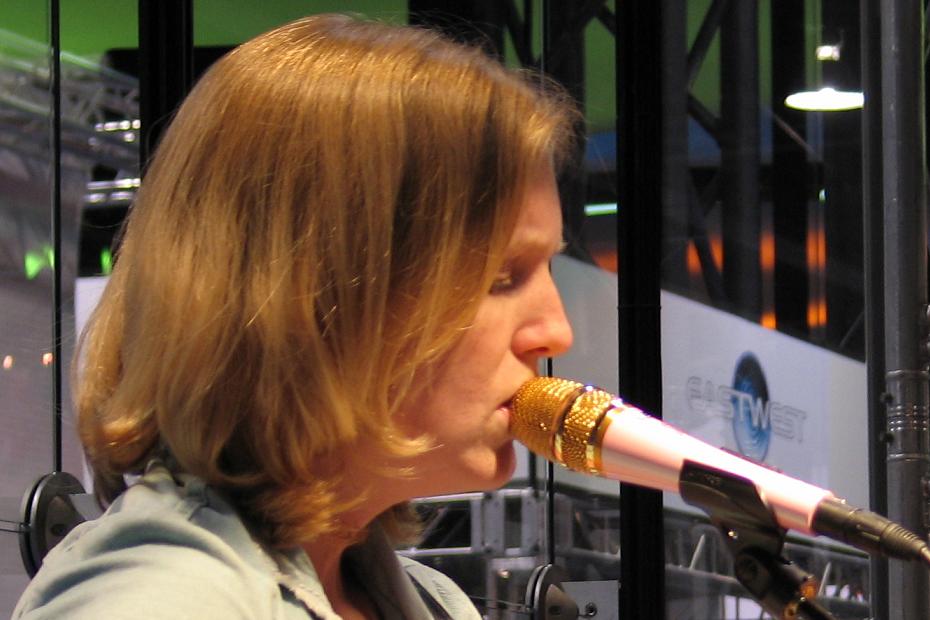
Laura Clapp from the US is a singer/songwriter, and has a brilliant voice used to great effect on her own tunes. The tunes are fantastic (some of them are almost beyond belief), with killer lyrics and devastatingly good musical arrangements combined with fantastic singing. For my money, Laura is even better live than on recording. For me, one of the magically engaging things in a performer is when you believe – when they look like they really mean it. Well, she looks like she means it, and I believe. Check her out here, or here.


If there's any musical justice in the world, these two artists should be huge...

Thursday, December 21, 2006

Believe!

The update on our city rivals Hearts should really be an annual affair – but events this season have proven so insane that it’s already past time to take stock. As we left season 05/06, we were in the managerial “Ivanauskas Era”. A handful of weeks into season 06/07, things have become so confusing that it’s not even clear which era we are in. So far, this is how the 06/07 season is shaping up:

The Ivanauskas Era (duration: 7 months)

Graham Rix lasts four months before being replaced in March 2006 by Valdas Ivanauskas. Following winning the Scottish cup at the end of last season, Ivanauskas takes Hearts to second in the league behind Celtic, within 3 points as late as 24th September 2006. On Thursday 28th, Sparta Prague eliminate the Jambos from the UEFA cup, ending their European involvement for the year. On 15th October Hearts concede 2 points in a 2-2 draw to Hibs, followed by a 2-0 home defeat to Kilmarnock on 21st October, and it’s at this point that things start to unravel.

Ivanauskas refused to talk to the media following the Kilmarnock loss, and immediately flew to Lithuania to talk with owner Romanov. It was allegedly agreed that the manager would take a 2-week break to recover from stress. On 23rd October Eduard Malofeev takes the reigns as a caretaker manager, and as Ivanauskas indicates (3rd November) that he is not ready to return. At this point, Hearts began to officially refer to his absence as “indefinite”, which seemed to imply that the Ivanauskas era had come to an end.

The Malofeev Era (duration: 6 weeks)

Within 3 days the dawn of this bright new era, Racing Genk in Belgium ask FIFA to ban Hearts from any further activity in the transfer market, claiming that they are due 80% of the €835,000 fee allegedly agreed for the sale of Mirsad Beslija to Hearts.

Then the real craziness begins.

On 27th October, Romanov is reported to have told the Hearts first team that they would be “all for sale” should they fail to win against Dunfermline. Club captain and Hearts legend Steven Pressley appears with other core players Paul Hartley and Craig Gordon, and collectively issue a public statement lamenting the situation at the club. Highlights from Pressley include this: “There is only so much coaching staff, a captain and certain colleagues can do without the full backing, direction and coherence of the manager and those running the football club… I have worked hard to retain unity. However, due to circumstances, morale understandably is no good and there is significant unrest in the dressing room”. Former chairman George Foulkes, SNP leader Alex Salmond, and the Scottish players union back the statement by the three key Hearts players.

On Saturday 28th October, Hearts play Dunfermline at Tynecastle (with Pressley, Hartley and Gordon all featuring), and draw 1-1. On the 31st, Julien Brellier indicates he may leave Hearts due to lack of first team action (Breillier having been one of the most contentious issues during Romanov’s reign, with the owner apparently unwilling to allow successive managers to select the player). Saturday 4th November sees Hearts go down 2-1 to Celtic in Glasgow. On 7th November, in one of the most surreal happenings (to date), Hearts send their “Sporting Director” Alex Koslovski to field a standard press conference alone. Normally acting as the translator for Malofeev, Koslovski is unable to answer any questions from the press regarding tactics, formations, or players. When questioned on the appearance of FBK Kaunas (also owned by Romanov) manager Eugenijus Riabovas at the Hearts training ground, Koslovski asserts that Riabovas is in Edinburgh only for “professional improvement”, and not to replace Ivanauskas.

On 13th November Falkirk draw 1-1 with Hearts with captain Pressley absent, and the following day, Hearts confirm that Riabovas is to take the reigns are Hearts as “Temporary Head Coach”, whilst insisting that Pressley was absent from the Falkirk game as he declared himself mentally unfit to play. There are later allegations that Pressley heard of a plot to oust him from the captaincy involving the Lithuanian members of his team, and subsequently refused to make himself available to play.

On 19th November Hearts go down 0-1 to Rangers in Edinburgh, again without Pressley.

Protests erupt outside Tynecastle resulting in several arrests of Hearts fans.

On Tuesday 21st, Riabovas promises Lithuanian media that he will be traveling to Edinburgh in December to take the position as Hearts head coach.

The Riabovas Era (duration: 0 days)

On 24th December, Hearts announce that Valdas Ivanauskas is returning to retake the reigns in Gorgie.

The Ivanauskas Era II (duration: ?)

On Saturday 25th as Hearts draw 0-0 with Inverness Caley Thistle with Pressley finally playing, fans “declare peace” with Romanov, after a meeting of fans groups are assured that Mr Romanov “has no influence on team selection”, and that “Steven Pressley remains captain of the club”. Romanov goes on to refer to Pressley as the “cement” in the Hearts organisation. Sporting director Koslovski insists that Pressley simply had to prove his readiness in training before reselection. On 2nd December, Pressley is omitted from the side again, and Hearts draw 2-2 with St Mirren – the players union hits out at the “unconventional” treatment of Pressley. 2 days later, Edgaras Jankauskas refutes any dressing room plot to oust the captain, and on 8th December, Ivanauskas promises Hearts are close to a resolution with Pressley.

The next day, Hearts beat Motherwell 4-1, and later that evening, it is announced that Pressley is leaving Hearts “by mutual consent”. In the same manner as most of the exiting staff during Romanov’s tenure, it appears that confidentiality is a condition of whatever agreement is in place between the parties.

15th December sees Craig Gordon named as the new Hearts skipper, and Ivanauskas confirm that Paul Hartley “has a future at the club” (presumably he “has a future” in the same way that Pressley was “the cement”). Both players have separate disciplinary meetings with Hearts management, and both remain silent following these meetings on what was discussed.

On 20th December, an open letter on the Hearts Supporters Trust website lambasts Romanov, accusing him of acting “like a playground bully”, and turning the club into a “playground freak show”.

So as Hearts go into the festive end of the season, take a breath, wrap yourself in tinsel and get the popcorn out – there’s plenty more entertainment where this came from!

Tuesday, October 03, 2006

You know... New York Style!

Ryanair – it seemed so good five years ago. Cheap flights, generally on time, basic but efficient service, not too painful in the cabin.

How things have changed.


Here are some of my favourite current things about Ryanair:


· Bright yellow interiors.

· Mostly plastic non-reclining seats.

· Mesh seatback pockets (on their older planes)

· No seatback pockets (on their newer planes)

· Emergency instructions glued to headrest in front of you

· Aggressive shrieking about scratch cards through the Cabin PA

· Advertising on overhead panels covering oxygen masks

· This is a dual use Sick Bag” – for photo development too!

· Airport in wrong location (“Glasgow” Prestwick, “Brussels” Charleroi)

· Extra charge to check in a bag.

· Derisory customer service.


Quite an attractive list. Still, paying extra to carry luggage only to arrive 40 miles from the city I am flying to may not be the biggest problem.

Recent TV programs have alleged that Ryanair pilots are routinely exhausted, and that they are paid a bonus for being on-time on their stand following landing, and a further bonus for being several minutes early. If that is true, then there is a clear financial incentive for pilots to be on time.

You know those TV “Crash Investigation” programs, when you see some company policy or behaviour, that would obviously lead to a culture of corner cutting?

Are there any dots to be joined here?


Setting aside the possibility of a life-ending crash (which will presumably occur whilst I search for my “dual use” sick bag, in my nonexistent seat-back pocket) - the final straw for me was flying from Liverpool to Dublin recently. You should always be wary when a menu starts getting a bit too informal with you. Surveying the options, my eyes met with an item whose description was deeply suspicious:


Oh, I know, do I?

Not only do I not “know”, I am very nearly certain that whatever abomination of a hotdog Ryanair chooses to serve up, it is likely to be very, very far from whatever “New York Style” is supposed to imply.

I say “nearly certainly”, because when I decided to order said hot dog, surprise surprise – they did not have any on board.

So from now on, until such times as Aer Lingus start charging for check-in bags, it is green and white for me.

You know… New York style!

Friday, August 18, 2006

It's all in the timing

The UK is under threat from terrorists.

They want to blow us up, because they hate our way of life.

Excuse me?

The illegal occupation of the West Bank and the Gaza strip by Israel (with massive US support going back years) has nothing to do with it. The occupation of Afghanistan has nothing to do with it. The occupation of Iraq has nothing to do with it. The threats, thrown so casually at Iran, have nothing to do with it. These people hate our way of life.

Here’s a time-saver for you - you don’t need to carefully check the foreign policy of the UK government (perish the thought) to assess whether there is a terror threat. The UK has an official threat level, which will tell you exactly how much these terrorists are hating our way of life at any particular moment.

When the threat level is low, you should only be vaguely frightened. When the threat level is high, you should presumably be in a state of constant panic.

Weren’t we the country who scoffed at the US threat level? Even the Onion parodied the ridiculous manipulation of fear provided by the oscillating threat warnings from the US administration.

We have all seen the magic trick where the magician, sleeves rolled up, has a coin in his hand. He passes his hands over each other a couple of times, and the coin vanishes. Just like it was never there.

As with most magic tricks, it's all in the timing.

The last time Blair was in serious domestic political trouble, there was a threat to the UK which was so immediate, it required a major deployment of the UK army to Heathrow airport in London. Camping outside the terminals in a mass show of force, and tramping up and down the lanes around Heathrow to guard against surface to air missiles, the mass mobilisation completely obliterated the front-page headlines swirling around the government and its policies.

Last week, as parliament was in absolute uproar over Blair’s capitulation to the US in not calling for an immediate ceasefire in Israel’s blood-curdling slaughter of Lebanese civilians, Blair looked like he might be in serious - potentially politically terminal - trouble. At that exact point, a threat emerged to the UK which was so immediate and serious, it required Heathrow to be shut down, hundreds of flights to be cancelled, and awkward new security measures to be put in place. You can hardly watch UK news at the moment without endless discussion of exactly what you can and can not take on your plane as hand luggage.

Of the arrested men and women in these recent ‘terror’ raids – how many exactly will be charged with terrorist offences?

Where did that coin go?